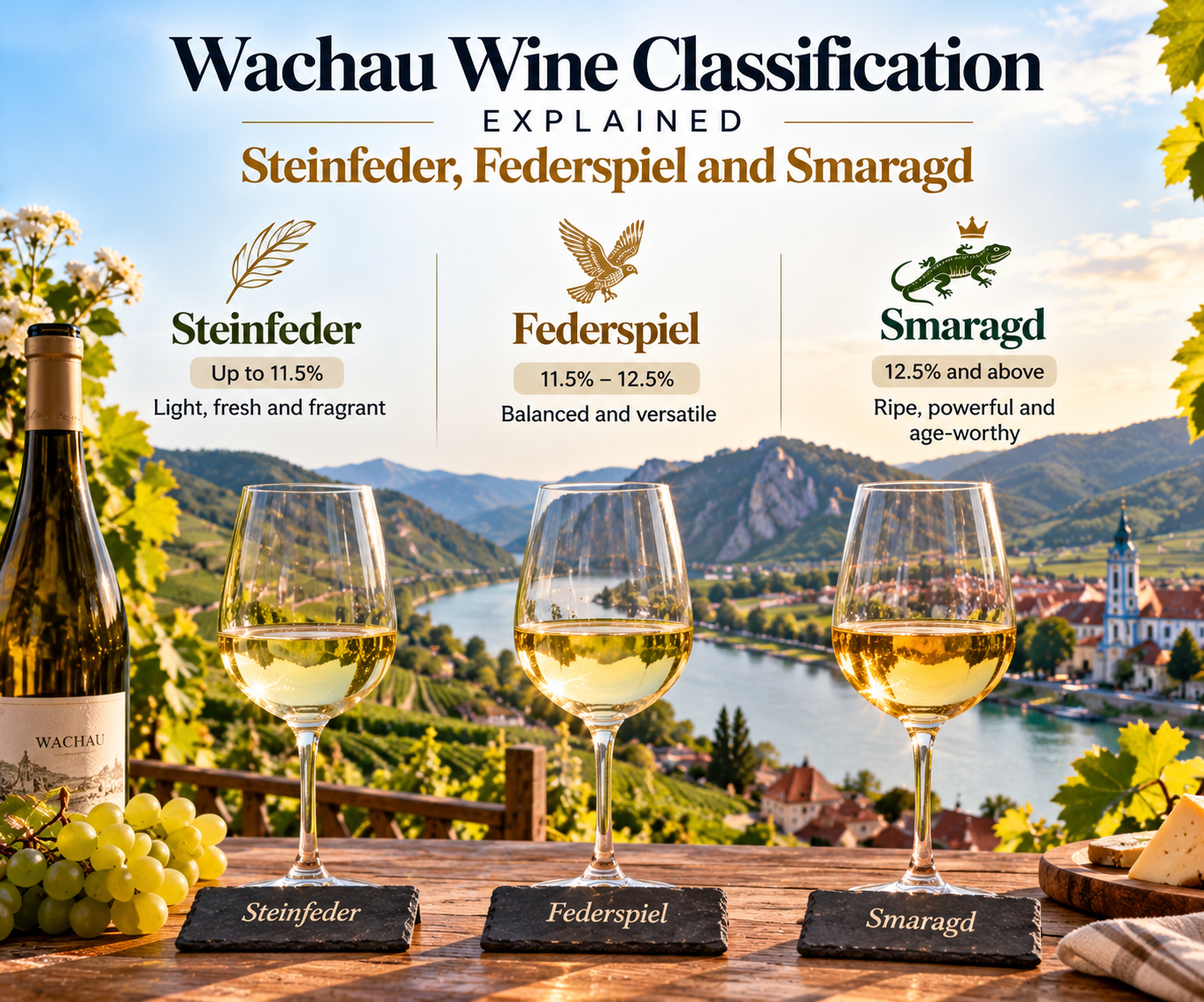
Walk into any wine cellar in the Wachau and you will see three words on the labels: Steinfeder, Federspiel, and Smaragd. They are not grape varieties, and they are not vineyard names. They tell you how ripe the grapes were at harvest and, as a result, how light or powerful the wine will taste.
This guide explains each tier in plain language. It covers the alcohol levels, the stories behind the names, and the grapes involved. It also offers simple tasting tips for a day trip, so you can order with confidence and pick a bottle that suits your taste.
Quick Answer
Steinfeder is the lightest style, with up to 11.5% alcohol. Federspiel sits in the middle, with 11.5% to 12.5%. Smaragd is the fullest and ripest, starting at 12.5%. All three are dry white wines made mainly from Grüner Veltliner and Riesling, and the names come from the Vinea Wachau producers’ association.
Details in this guide were last checked in October 2026.
What the Classification Is and Who Runs It
The system belongs to the Vinea Wachau Nobilis Districtus, a group of growers founded in 1983. It now includes around 200 wine estates. The three names are registered brands, and only members who follow the group’s rules may use them.
Those rules are strict. In 2006 the association proclaimed the Codex Wachau, which commits members to making these wines naturally and without enrichment. Members also press and bottle the wine within the Wachau. A producer who cannot meet the codex may not label a wine as Steinfeder, Federspiel, or Smaragd.
One producer compares the three styles to singing voices: bass, baritone, and tenor. The comparison is handy because it reminds you that the tiers describe style and weight rather than quality alone.
Steinfeder: The Light One
Steinfeder is the lightest tier, with a maximum of 11.5% alcohol. It is fresh, fragrant, and made for easy drinking, often while the wine is young. Producers describe it as feather-light, and the name fits. It refers to a feathery grass that grows on the rocky terraces of the Wachau.
Choose Steinfeder when you want a refreshing glass at lunch, a light aperitif, or a wine for a warm afternoon on a terrace.
Federspiel: The Balanced Middle
Federspiel sits between the other two, with alcohol from 11.5% to 12.5%. Commonly cited rules also set a minimum must weight of 17 degrees KMW, which is Austria’s scale for the sugar in grape juice. Federspiel is dry, with more texture than Steinfeder but less power than Smaragd.
The name comes from falconry, a form of hunting once popular in the valley, and it refers to the lure used to call a hunting bird back. Many visitors find Federspiel the most versatile tier because it works with a wide range of dishes and still allows a second glass.
Smaragd: The Ripe and Powerful One
Smaragd is the top tier, with a minimum of 12.5% alcohol. Commonly cited rules add a minimum must weight of 18.5 degrees KMW. Wines at this level can reach 15% and offer the greatest concentration, weight, and aromatic depth. The best examples from the finest terraced vineyards age for decades.
The name refers to the emerald lizard, a green reptile that sunbathes among the vines on the Wachau slopes. The term was first used in the 1980s and now stands for the most valuable wines of the valley.
Choose Smaragd for a special meal, for rich food, or when you want a bottle to keep. These wines usually cost more than the lighter tiers.
Comparison Table: The Three Styles
| Style | Alcohol | Character | Name Comes From | Good With |
|---|---|---|---|---|
| Steinfeder | Up to 11.5% | Light, fresh, fragrant | A feathery grass on the terraces | Light dishes, aperitif |
| Federspiel | 11.5% to 12.5% | Balanced, versatile | Falconry lure | A wide range of dishes |
| Smaragd | 12.5% and above | Ripe, powerful, long-lived | The emerald lizard | Richer plates, special meals |
Which Grapes Are Involved?
Two grapes dominate the Wachau: Grüner Veltliner and Riesling. The three tiers apply to both. A Federspiel Riesling and a Federspiel Grüner Veltliner share the same ripeness level, but they taste very different. Grüner Veltliner tends to show a peppery, savory side, while Riesling leans toward stone and citrus.
The tiers measure ripeness and alcohol, not sweetness. All three styles are made as dry wines.
How the Newer DAC System Fits In
In 2020 the Wachau also introduced a DAC system, which classifies wines by origin in three levels: regional, village, and single vineyard. The Vinea Wachau terms did not disappear. Producers describe the two systems as complementary, with the DAC describing where the wine comes from and the Vinea terms describing its style.
On a label you may therefore see both a place name and one of the three Vinea words. Read them as two pieces of information.
How to Taste Like You Know What You’re Doing
- Taste in order from Steinfeder to Federspiel to Smaragd, so the lighter wines do not get lost after a powerful one.
- Compare the same grape across two tiers to hear the difference ripeness makes.
- Ask the grower which vineyard each wine comes from and why it tastes the way it does.
- Match intensity to food: light dishes with Steinfeder, versatile courses with Federspiel, and richer plates with Smaragd.
- Buy Steinfeder to drink soon and Smaragd if you want to age a bottle.
Tasting on a Day Trip
A wine day in the Wachau only works if nobody has to drive. A private driver takes you between towns like Dürnstein, Spitz, and Krems, waits while you taste, and brings you home to Vienna. That also lets you linger over a longer tasting rather than rushing to protect the designated driver.
Frequently Asked Questions
What is the difference between Steinfeder, Federspiel, and Smaragd?
They are three Wachau wine styles based on ripeness and alcohol. Steinfeder is the lightest, Federspiel sits in the middle, and Smaragd is the fullest and most age-worthy.
Which Wachau wine style is best for beginners?
Federspiel is a good place to start. It is balanced, versatile with food, and less heavy than Smaragd.
Are Steinfeder, Federspiel, and Smaragd sweet?
No. The tiers describe ripeness and alcohol, and all three are dry wines.
What grapes are used for these wines?
Grüner Veltliner and Riesling are the two main grapes in the Wachau, and both appear in all three tiers.
Who created the classification?
The Vinea Wachau Nobilis Districtus, a growers’ association founded in 1983, created the system. Only members who follow its codex may use the three brand names.
Is Smaragd worth the higher price?
For special meals and for aging, yes. For casual drinking or a warm afternoon, Steinfeder or Federspiel often suits the moment better.
Order With Confidence
Once you know the three words, a Wachau wine list stops being a puzzle. Start light, move up through the tiers, and let the grower guide you. A private day trip from Vienna lets you taste properly, because the driving is already taken care of.


Related posts


RECENT POSTS
ABOUT
Pellentesque sed risus feugiat lectus ornare pharetra nec id nisl. Sed dictum nunc a elit gravida consequat. In non accumsan nibh. Mauris at libero id magna viverra rutrum vel et felis. Suspendisse blandit tellus sed metus suscipit molestie.
Leave a Comment