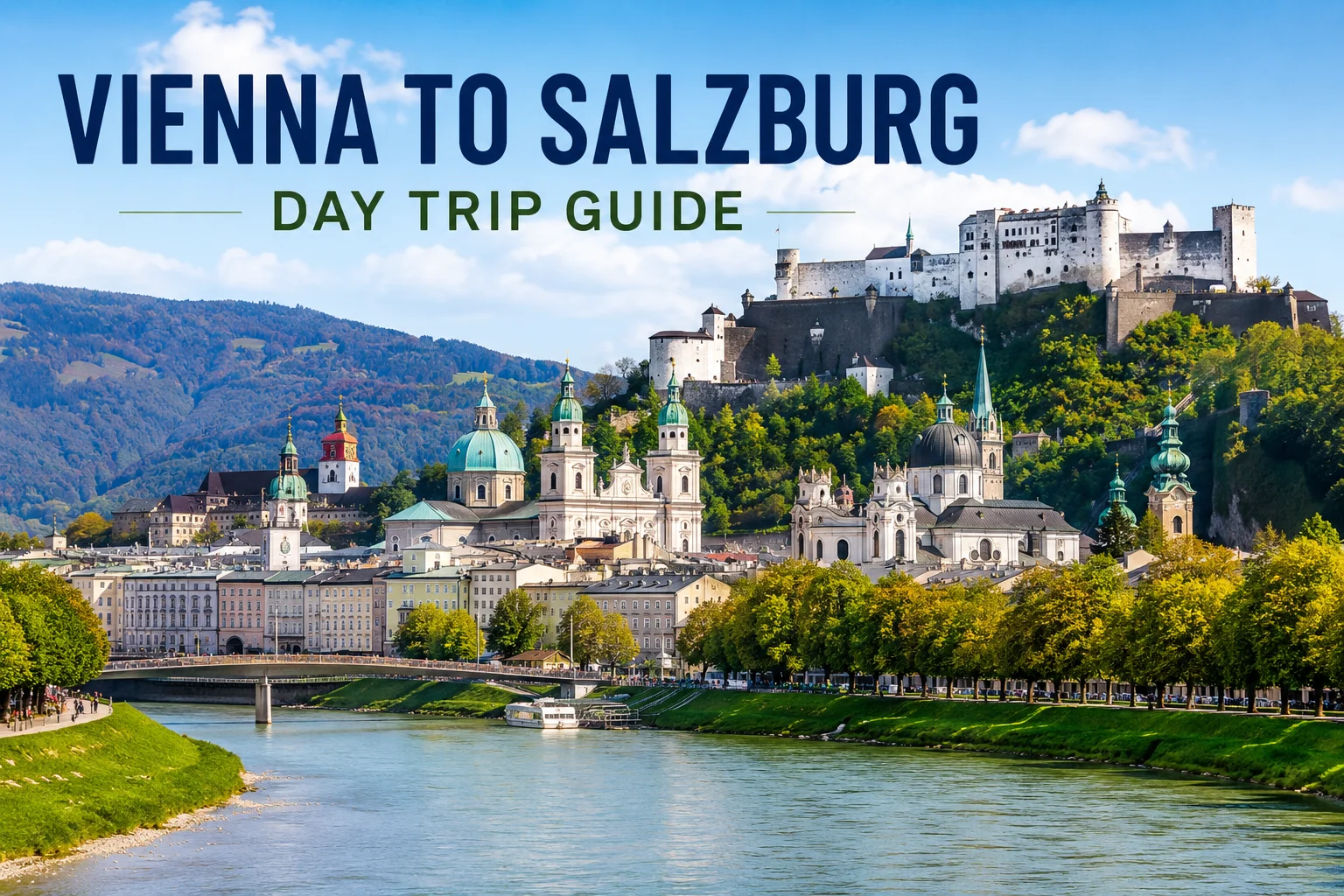
Yes, and if you plan it right, it will be one of the better days of your Austria trip. The two cities sit about 300 kilometers apart, the train runs frequently, and Salzburg’s main sights are compact enough that six to seven hours on the ground covers them at a real pace, not a sprint.
The catch is that a day trip to Salzburg only works well if you get two things right upfront: what time you leave Vienna and how you get there. Get those right and the day falls into place naturally. Get them wrong and you will spend your best hours in transit or standing in queues that were entirely avoidable.
How Far Is Salzburg from Vienna?
Salzburg is approximately 300 kilometers from Vienna by road. The ÖBB Railjet train covers the route in around 2 hours and 25 minutes, with departures from Wien Hauptbahnhof every 20 minutes throughout the day. By car or private transfer via the A1 West Autobahn, the drive takes between 2.5 and 3 hours in normal traffic.
To put that in perspective: Austria stretches roughly 560 kilometers from east to west, and Vienna sits on the country’s far eastern edge. Salzburg is almost halfway across, in the north-central region where the flat land starts giving way to the pre-Alpine foothills. The route passes through the Linz basin, and the scenery improves noticeably in the final 80 kilometers before Salzburg.
Traffic near Vienna and Linz tends to build between 6:30 and 9:30 on weekday mornings, and again from around 3:30 in the afternoon. If you are driving or taking a private transfer, that is worth factoring into your departure window.
One number worth keeping in mind: Salzburg draws close to 3 million overnight visitors a year, in a city of only about 155,000 residents. A large share of those visitors are day-trippers from Vienna. This is a well-worn route with reliable infrastructure built around it.
What Are the Best Ways to Get from Vienna to Salzburg for a Day Trip?
There are four realistic options: train, private chauffeur transfer, bus, and self-drive. Each suits a different type of traveler, so the right answer depends on your situation.
By Train (ÖBB Railjet)
The Railjet is what most people choose, and it earns that default status. Trains leave Wien Hauptbahnhof every 20 minutes, arrive at Salzburg Hauptbahnhof in about 2 hours and 25 minutes, and the carriages are comfortable enough to read, work, or just watch the countryside pass. Tickets range from roughly €40 to €160 one-way depending on class and how far ahead you book. The ÖBB app handles everything from purchase to boarding.
The real limitation for a day trip is that the train runs station to station, not door to door. Getting from your Vienna hotel to Wien Hauptbahnhof, and then from Salzburg Hauptbahnhof to your first attraction, adds around 30 to 45 minutes at each end. Over a day where your total window in Salzburg is seven hours, that adds up. During peak season, Salzburg Hauptbahnhof is also busier than most people expect, and navigating it with children or luggage takes longer than the timetable suggests.
Seat reservations are strongly recommended in summer and on weekends. The trains fill.
By Private Chauffeur Transfer
A private door-to-door service picks you up directly from your Vienna hotel and drops you at your preferred starting point in Salzburg, usually near the Old Town entrance or the Fortress funicular. On the return, your driver collects you from whatever point makes sense at the end of the day. The drive takes around 2.5 to 3 hours each way.
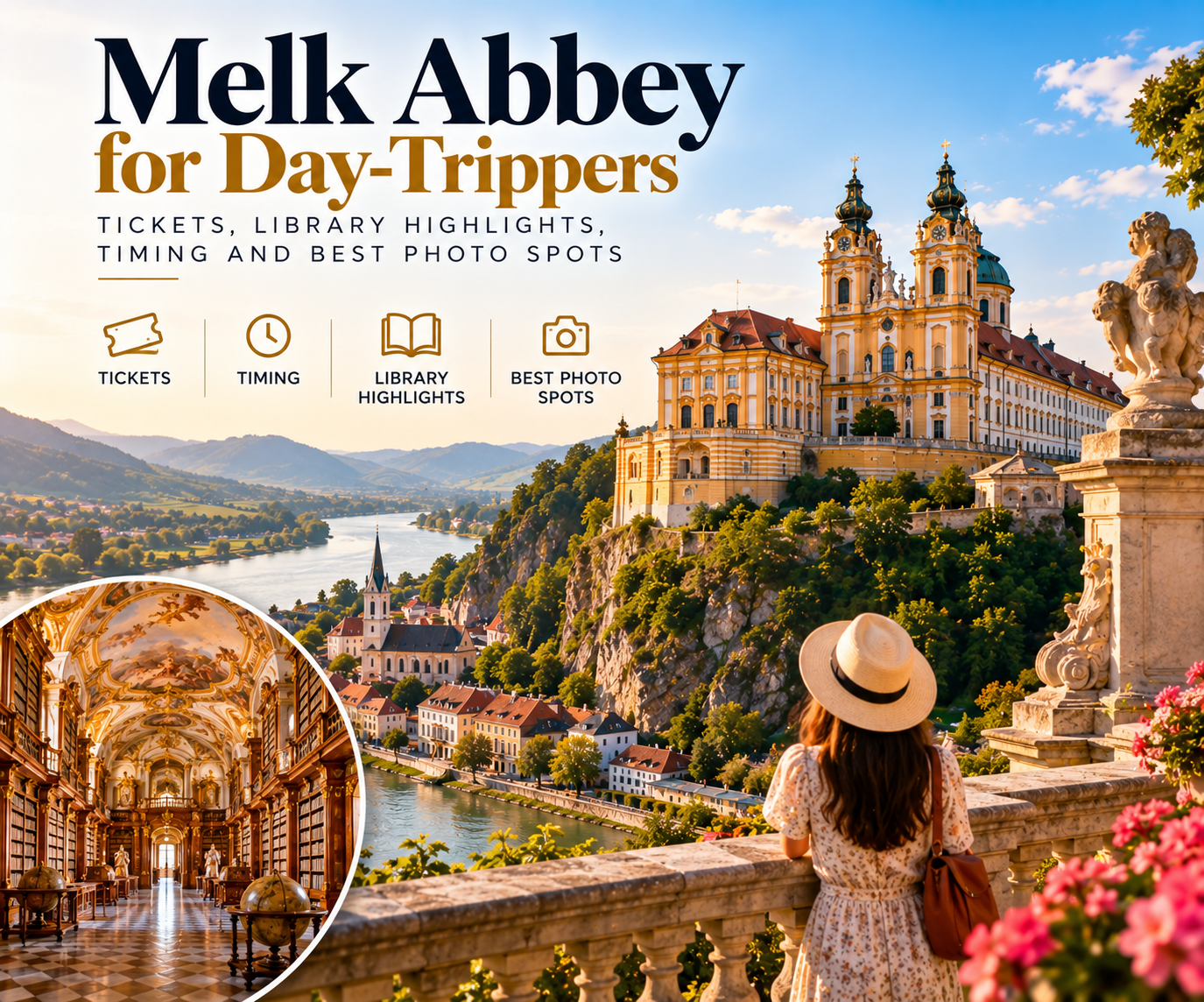
The time saving over the train is tangible. Eliminating two sets of station transfers typically recovers 45 to 90 minutes across the full day. In a seven-hour window in Salzburg, that is a meaningful difference. A private transfer also makes it possible to stop somewhere en route that the train cannot offer. Melk Abbey, a baroque Benedictine monastery perched on a cliff above the Danube about 75 kilometers west of Vienna, is a popular detour that adds less than an hour to the journey and is worth the stop if your schedule allows it.
Vienna Day Trip operates this route with a fleet of Mercedes vehicles, including E-Class for couples and solo travelers, S-Class for executive travel, and V-Class for families and groups. All drivers are licensed professional chauffeurs. The service carries both passenger transportation and company liability insurance, operates fully licensed with the required permissions for cross-European passenger transport, and offers free cancellation up to 24 hours before pickup.
For families with young children, groups of three or more, or anyone who does not want to think about logistics on a one-day trip, this removes the administrative layer from the day entirely.
By Bus
FlixBus covers the Vienna to Salzburg route starting around €26 to €50. The journey takes close to four hours each way, including transfers. That is a round trip of eight hours of travel for six hours in Salzburg. It works if budget is the primary constraint, but it is not a day trip format that most people would choose twice.
Self-Drive
Driving takes about three hours via the A1 West Autobahn under normal conditions. If you enjoy driving in continental Europe and want the freedom to stop where you like, it is a practical option. Two things need sorting before you go: Austria requires a valid motorway vignette (toll sticker), available at most petrol stations and online, and parking near Salzburg’s Old Town is both limited and expensive. The Park and Ride facilities on the city outskirts are the sensible solution. The center is largely pedestrian anyway, so you will be parking on the periphery regardless of where you leave the car.
The honest tradeoff is fatigue. Six hours of driving plus a full day of walking, and you will cover 10 to 12 kilometers on foot in Salzburg. Not everyone finds that appealing.
What Time Should You Leave Vienna for a Day Trip to Salzburg?
Leave Vienna between 7:00 and 8:00 AM. This puts you in Salzburg by 10:00 to 10:30 AM, which is early enough to reach Hohensalzburg Fortress before the crowd builds at mid-morning. Plan to leave Salzburg between 5:00 and 6:00 PM, which gets you back to Vienna by 7:30 to 9:00 PM.
That window gives you roughly seven hours on the ground. Salzburg’s Old Town is compact. The main sights sit within about a 1.5-kilometer radius, and seven hours is genuinely enough to cover the fortress, the historic center, Mozart’s Birthplace, and Mirabell Gardens without feeling rushed.
Leaving Vienna after 9:00 AM changes the math. You arrive in Salzburg around noon, when the fortress queue has already formed and the better restaurant tables have gone. Your window before the return journey shrinks to five hours or fewer. That is enough for a partial visit, not a full one.
Train travelers should check the ÖBB timetable the night before and choose a departure that arrives in Salzburg no later than 10:30 AM. Those booking a private chauffeur should confirm the hotel pickup time when reserving. A 7:30 AM departure from Vienna tends to work well and gives a comfortable buffer for the drive.
What Can You See in Salzburg in One Day?
Quite a bit, if you sequence the attractions sensibly. Here is how the day actually flows when you arrive by 10:00 AM.
Start at Hohensalzburg Fortress (Arrive by 10:00 AM, Allow 1.5 to 2 Hours)
This is the right starting point for a straightforward reason: it gets crowded from mid-morning, and the views are best before the day fully opens up. The fortress sits 120 meters above the Old Town on Festungsberg hill. You reach it either via the FestungsBahn funicular (Austria’s oldest, tracing its origins to 1515) or on foot up a steep but walkable path.
The numbers give you a sense of what you are looking at: Hohensalzburg Fortress covers 32,000 square meters and is the largest fully preserved medieval castle complex in Central Europe. Archbishop Gebhard began construction in 1077, and the fortifications were rebuilt and extended extensively around 1500 under Archbishop Leonhard von Keutschach. In its entire history, the fortress was never captured by foreign troops, which is a notable distinction for a structure nearly a thousand years old.
Inside, the Fortress Museum traces the court life of the prince-archbishops who shaped the city. The Puppet Museum and Rainer Regiment Museum are worth a look if you have children or a particular interest in either subject. From the ramparts, you get the panoramic view that appears in every Salzburg photograph: church domes, the Salzach River, and the Alps in the distance. Book tickets in advance if you are visiting between June and August; lines build quickly after 10:30 AM. Entry is free with the Salzburg Card.
The UNESCO Old Town and Getreidegasse (10:30 AM to 12:30 PM)
From the fortress, work your way down into the Old Town. Salzburg’s historic center is a UNESCO World Cultural Heritage Site and one of the most coherently preserved Baroque city cores in Europe. Walking it without a fixed plan actually works. It is compact enough that the main squares connect naturally and you will stumble across most of what matters simply by following the streets.
A few things deserve specific attention. Getreidegasse is the main commercial street, lined with wrought-iron guild signs that merchants have been hanging since the city was a trading hub. At number 9 is Mozart’s Birthplace, the house where Wolfgang Amadeus Mozart was born on January 27, 1756. It is one of Austria’s most-visited museums, featuring his childhood instruments, family letters, and the clavichord he played as a child. The exhibits are well put together and take about 45 minutes to move through properly. Booking in advance is increasingly recommended during peak season.
From Getreidegasse, continue south to Residenzplatz and Domplatz. The Salzburg Cathedral, with its twin towers visible from most parts of the city, is the most visited single attraction in Salzburg. A walk through the interior takes around 15 minutes. Kapitelplatz, just behind it, has an oversized golden ball sculpture and mountain views that make for a better photograph than most people expect. Goldgasse, a short street off Residenzplatz, is worth a detour if you want to look at local artisan work.
If you need coffee by this point, Café Tomaselli on Alter Markt has been open since 1703. It was a regular stop for Mozart and is Austria’s oldest café. Arrive before noon to get a table without waiting.
Mirabell Palace and Gardens (1:00 PM to 2:30 PM)
Cross the Salzach River and spend your early afternoon at Mirabell Palace and its Baroque gardens. The gardens are free to enter and a short walk from the Old Town.
Most visitors come partly for the Sound of Music connection. The Pegasus Fountain and the Grand Staircase appeared in the “Do-Re-Mi” scene, filmed here in 1965. The film has drawn hundreds of thousands of fans to Salzburg annually for decades and has become genuinely embedded in the city’s identity. As the CEO of Tourismus Salzburg once noted publicly, most locals had never actually seen it until tourists started asking about it. The gardens are photogenic regardless of whether the film means anything to you.
The Marble Hall inside the palace is where Mozart performed as a child and where concerts still run regularly. If you are staying into the evening, a concert here is worth booking. Directly across on Makartplatz is Mozart’s Residence, where the Mozart family lived after leaving Getreidegasse. If the birthplace museum left you wanting more context, this is the logical next stop.
Optional Afternoon (2:30 PM to 4:30 PM)
If the Sound of Music is a primary reason for the visit, a dedicated walking or minibus tour covers Nonnberg Abbey, Leopoldskron Palace, and other filming locations in about two hours. Book it well in advance. The most popular tours sell out in summer.
Hellbrunn Palace, a 17th-century pleasure retreat famous for its trick fountains, sits about 20 minutes outside the Old Town. It is particularly good for families with children. Getting there without a car means a taxi or joining a tour that includes it. If you are returning to Vienna with a private chauffeur, you can ask your driver to factor a Hellbrunn stop into the schedule before heading back.
If you would rather move slowly through the Old Town and sit down for a proper meal, that is equally valid. There is no obligation to fill every hour.
Is One Day Enough to See Salzburg?
For the core of Salzburg, yes. The fortress, the UNESCO Old Town, Mozart’s Birthplace, and Mirabell Gardens are all within comfortable walking distance of each other, and a seven-hour window covers them without rushing. Salzburg is compact in a way that Vienna is not. You will not spend 30 minutes walking between attractions.
What a single day does not give you: the full Sound of Music tour, which takes three to four hours on its own; Hellbrunn Palace at a relaxed pace; and any evening events. The concerts at the fortress, Mirabell, and St. Peter’s Stiftskulinarium all start between 6:00 and 8:00 PM, after most day-trippers have already gone.
If the Sound of Music locations are the main motivation for the trip, an overnight is worth considering. That gives you the dedicated tour plus the standard sightseeing without trying to fit both into one day.
Most group bus tours from Vienna allocate only two to three hours of free time in Salzburg. That is a partial visit at best. A private day trip where you control the schedule is a different experience entirely. You spend the day exploring rather than timing your return to a coach.
What Is the Best Time of Year to Do a Day Trip from Vienna to Salzburg?
Spring: April and May
Temperatures settle in the range of 10 to 20°C. The Mirabell Gardens are in bloom from late April, which is when they photograph best. Crowds are manageable, prices for tours and activities are lower than summer, and daylight runs longer than it does in autumn. May is probably the most underrated month for this trip. The ski season is over, the summer rush has not started, and the city has a quieter rhythm that peak season does not allow.
Summer: June through August
The Salzburg Festival runs from mid-July through August and draws opera, theatre, and classical music audiences from across Europe. If that is the draw, summer is the right time regardless of the crowds. If performing arts are not the motivation, peak season brings fortress queues that can reach 30 minutes or more, higher prices across the board, and an Old Town that is more hectic than the promotional photographs suggest. Book everything weeks in advance if you are going in July or August.
Autumn: September and October
This is the window most experienced travelers recommend. Temperatures hold between 15 and 22°C. The summer crowds thin in September and drop off further in October. The surrounding hills take on autumn color, which makes the fortress views and the Salzach valley look noticeably different from the summer version. Prices come down from their peak. For travelers without a specific event in mind, autumn gives the best combination of weather, atmosphere, and room to breathe.
Winter: November and December
Salzburg’s Christmas markets are genuinely famous rather than just tourist-promoted. The Christkindlmarkt in front of Hohensalzburg Fortress, lit up against the medieval walls, is one of the more striking market settings in Central Europe. Daylight hours are short (six or seven hours regardless of pace), and temperatures sit around 0 to 8°C. It is a good reason to make the trip; just dress for it and make peace with the compressed timeline.
Practical Tips That Actually Make a Difference
1. Leave early. Arriving in Salzburg before 10:30 AM is the single most useful thing you can do. The fortress is quieter, the streets are less crowded, and you have better light for photographs before the tour groups arrive. Everything else in this list matters less than this one decision.
2. Book the fortress before you go. Tickets bought online are slightly cheaper than at the gate and let you walk past the queue. This matters between June and August. In shoulder season it is less critical, but there is no reason not to sort it in advance.
3. Consider the Salzburg Card if you plan to visit three or more paid attractions. The card covers fortress entry and funicular, Mozart’s Birthplace, Mozart’s Residence, most other museums, and unlimited city public transportation. For a day-tripper hitting multiple sites, it pays for itself quickly.
4. Visit the fortress first, the Old Town second. The fortress is the most logistically demanding attraction, with funicular capacity, timed entry during peak season, and crowd buildup after 10:30 AM. The Old Town can be walked at any hour. Tackle the constrained thing first.
5. Eat lunch before 12:30. Restaurants around Residenzplatz and Getreidegasse fill up from around 12:30 to 2:00 PM. If you move through the fortress early and reach the Old Town by noon, you can sit down for lunch before the rush rather than waiting outside.
6. Wear shoes you can actually walk in. The Old Town is entirely cobblestone, the climb to the fortress is steep, and you will cover 10 to 12 kilometers on foot across the day. This is a practical note, not a stylistic one.
7. Know your return time before the day starts. If you are on the train, check your departure from Salzburg Hauptbahnhof the night before and keep it in mind. If you have a private chauffeur, confirm the pickup time and location that morning. Knowing the hard endpoint at the start of the day prevents the uncomfortable scramble at the end.
Private Chauffeur or Train: Which Makes More Sense?
For solo travelers and budget-conscious visitors who are comfortable navigating stations, the train works well. It is frequent and reliable, and the journey is pleasant. There is nothing wrong with it as an option.
The calculus changes for families, groups, or anyone doing this as a special occasion. A family of four buying round-trip first-class Railjet tickets spends somewhere in the range of €240 to €480 depending on booking timing. A private transfer for the same group, in a Mercedes V-Class with a professional chauffeur and the ability to add stops along the route, often lands within a comparable price range, with a materially different experience on both ends of the journey.
Beyond cost, there is the time question. Door-to-door pickup in Vienna and drop-off at the starting point in Salzburg eliminates two sets of station transfers. That typically recovers 45 to 90 minutes across the day. When your total window in Salzburg is seven hours, gaining an hour back is not a small thing.
Vienna Day Trip’s Salzburg service operates with fully licensed professional chauffeurs, passenger transportation insurance, and company liability insurance in place. The team has been running private day trips from Vienna for over seven years. Cancellation is free up to 24 hours before departure, and the itinerary can be adjusted to include stops like Melk Abbey or a scenic pause through the Salzkammergut on the way back.
The straightforward answer: the train is a good choice. A private chauffeur is a better one when the quality of the day matters as much as reaching the destination.
Is a Day Trip from Vienna to Salzburg Worth It?
Salzburg draws nearly 3 million overnight visitors a year, in a city of 155,000 people, and generates roughly €1 billion annually from tourism. Those numbers reflect something real about the city. Day-trippers from Vienna have been making this journey for a long time, and the city has not run out of things to offer them.
The UNESCO-listed Old Town is among the most intact Baroque urban environments in Europe. The fortress on the hill has stood since 1077 and has never been taken. The birthplace of one of the most consequential composers in the history of Western music sits on a walking street lined with iron guild signs, and on a clear morning, standing on the fortress ramparts looking over the domes and the river toward the Alps, it is the kind of view that does not need any framing to justify the trip.
One day does not cover everything in Salzburg. But it covers the real thing, not a compressed impression of it.
Ready to Book Your Salzburg Day Trip from Vienna?
Vienna Day Trip offers private chauffeur day trips from Vienna to Salzburg with door-to-door Mercedes service, fully licensed professional drivers, and a flexible itinerary built around your schedule. The service carries passenger transportation and company liability insurance, and free cancellation applies up to 24 hours before pickup.
If you are also considering other destinations from Vienna, the same private day trip format covers Hallstatt, Budapest, and Bratislava. Each works as a full day from Vienna and pairs well with a longer Austria stay.


Comments
[…] your day trip from Vienna leaves you with less time than a full day in Salzburg, prioritize the fortress and old town over Mirabell Gardens, since the gardens, while pleasant, are […]